Monday, September 8, 2008

Green Between the Cracks

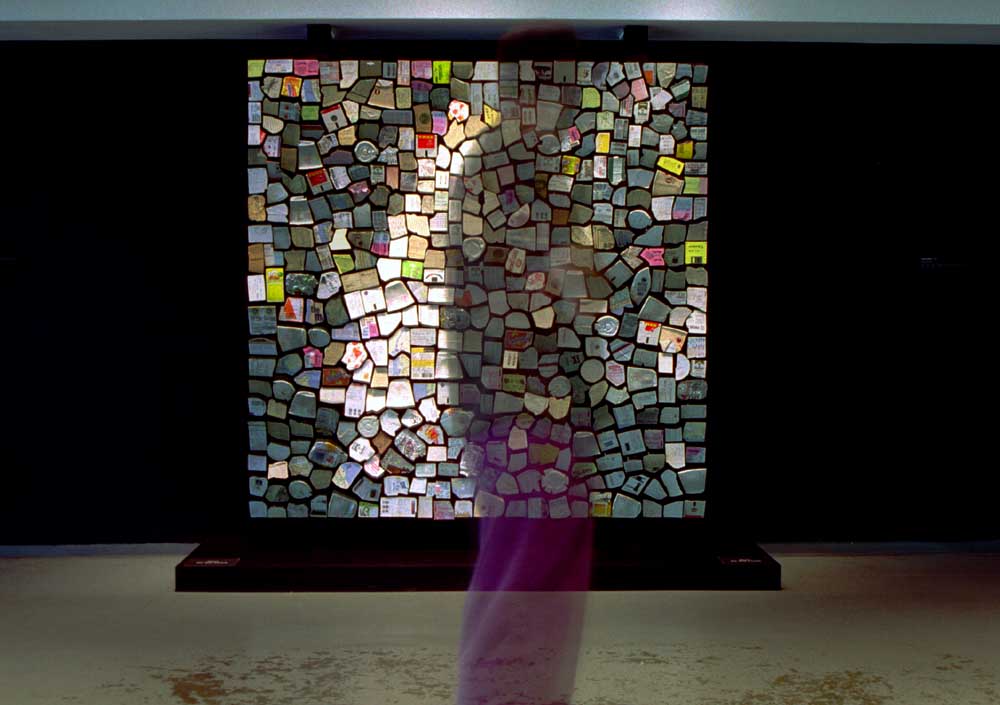
The influences of guerilla gardenning and trash mirrors converge, in this post about moss-based graffiti:


The graffiti is grown in lines of text, the wall framing a single line of a larger poem - the entirety of which will show up over time on various walls around town. Not quite as responsive as the trash mirrors, but also reflective - in a different way.

Perhaps there's also something of the telectroscope here too, in the emergent connection of different places.

20 Masterpieces of Green Graffiti [Environmental Graffiti]

Friday, August 29, 2008

Draft 1: Zoom, Pan, Rotate


"URBAN ECOLOGY" - the rapidly narrowing title for my graduation project.

Music by Mason Jennings.
2 minutes of video, composed from renders using 3D Max.


Draft 1 further details my investigations into ownership and environment. This research is broached by tracing urban bodies of such a scale that people are like cells in a living creature. Such an image is foreboding and wondrous at the same time. Symbiotic with this great creature are a variety of smaller creatures. These smaller creatures evolve by necessity in such a way as to recombine elements dispersed by the larger creature. Thus my research takes the guise of a life cycle and interdependency diagram that has a life of its own.

The diagram is navigated by assigning zoom, pan and rotate to various modes.

Zoom associates with Point of View, such as the identifiable everyday experience of travelling through a transport tunnel. Point of View later allows the viewer to become other things, such as the smog itself; the viewer zooms away from the ventilation stack and gains an aerial view seen more often by birds than people.

Pan associates with systemic mapping. The viewer gains a sense of larger symphonies, such as the tunnel. It carries smog to ventilation stacks, but is also like a leaky pipe; Seeds flow within and around it, being nourished and finding cracks to grow in. Systemic mapping starts with a known item (the tunnel) and ends by mapping a new, unrecognised system (the smog island, complete with craters).

Rotate associates with growth; a community garden ekes out of the cracks between concrete boxes. Growth is the devalued creating value of itself, a garden carving a rotated crater from solid smog – and establishing a prime economic market of carbon offsets.

Rising problems caused symbolically and realistically by the ventilation stack are visualised as decreasing distinctiveness in our urban environment. Thus as smog rises from our tunnels, it rises from the ground as a solid barrier – an urban island of oppressive solidity. This veil is not just smog, it is the sealed earth and manicured public gardens which tolerate little creatures only as outlaws. From and with this solid mass, various potentials are created. Existing elements, otherwise in a state of dispersal (such as locals losing out in a wave of gentrification) are able to recombine in successful ways. (Community) seeds can be planted, (economic) landscapes sculpted and (ecological) worlds can be uncovered.

Thursday, August 14, 2008

Valuing the Devalued

This relates to my Experiment 2 texture series about Discarded/Devalued, as well as Portals. If we can find honest value in the humble or downtrodden, we will be able to face our own problems with conviction.


"This piece suggests that we are reflected in what we discard. The piece celebrates the ability of computation to inflict order on even the messiest of substances - trash."
-DANIEL ROZIN, about his Trash Mirror.

Friday, July 11, 2008

Interopable Worlds...

... or, Fluid Activities in Many Native Environments

In "Virtual teleportation arrives" on Thursday, Aharon Etengoff says that "teleporting an avatar between platforms will undoubtedly have a significant impact on the future of virtual worlds. Indeed, an open standard for interoperability would permit users to cross seamlessly from one three-dimensional universe to another."

To me, the advantage of "teleportation" between worlds would be in moving more than just your individual appearance. As one commenter notes, just being able to move your avatar would be like "being in facebook and being able to switch to myspace without having to type your username and password again. Nice, but not earthshaking."

As another commenter sees it, "My buds and I might be in a game of BF2342 some day and escape an ambush by being teleported into the Sims10, then over to Quake Wars7 grab some new weapons and teleport back to the BF2732 game just behind our ambushers and zap em?"

- YES! You should be able to move so fluidly between worlds, with your objects and friends, that you can put each environment to its highest and best use, without messing up your train of thought. You should be able to span your activities across multiple worlds, because each world has its own rules, process and value in what you're doing. More than that, when you move from place to place, it's not just you and your files that're moving. Most of the time you're in the middle of a social activity, so you should be able to move with your friends by your side - rather than losing and regaining contact once you arrive. Portals should frame social settings, digital or not.

We shouldn't be looking at digital design in terms of booleans and polygons, we should be looking at swarming, cellular automata and other fluid patterning. And in our increasingly internet-augmented real world, people may demand more fluidly porous ways of navigating our places.

Virtual Teleportation Arrives, And Is Commented On [The Enquirer]

Wednesday, July 9, 2008

Powerthirst

I was going to post something deeply meaningful, but instead I found a video which embodies everything I would like to be able to do with machinima. It's awesome.

Saturday, June 21, 2008

Research Abstract

DESIGN, INNOVATE, MARKET

Living in the city is not an easy prospect. Proximity to high quality facilities is paid for with small private spaces, high costs, community tension and delirious places. People can often get lost in the equation – this is demonstrated near the chosen project site with large numbers of “keep out” signs and a looming ventilation stack operated by a corporation. The stack spews out concentrated smog from cars passing far below the surface, not to mention the loud and obnoxious stream of motor vehicles to be found above ground at what is a key intersection for Sydney’s traffic. Perhaps this is not such a healthy site for healthcare to take place.

Evidence of individual attempts to fight back are also to be found: graffiti extends individual ownership over places which are otherwise alienating. For instance, the prominently located, intricate pattern of cups lodged into a barbed wire fence. A back-street attempt at fighting back also includes a private garden overflowing onto public sidewalk. Such displays are exciting and interesting, but only exist on the surface. Surry Hills, Darlinghurst and Paddington are areas where a large number of small creative elements are able to combine and build character as community. Surely something truly powerful can be achieved through coordination.

Thus two major issues are to be dealt with in this project: First, a preventative health care umbrella to address the local and wide-reaching issue of air pollution. Second, enabling the mediation of big organizations and a potentially strong community. It should be noted that health is always personal, and good health is rarely found in isolation.

Precedents to address this nexus are to be found locally and overseas. Community gardens, while present in a few suburbs, are undervalued in Sydney for their widely affecting qualities; they are used quite effectively in education, addressing environmental health and for social support structures in cities such as Chicago. A community garden would however only address some of the issues. If organised in synergy with operations such as the “Spare the Air” campaign, a public living room, and environmental awareness spaces, a true umbrella might be lifted over the heads of local residents to address the issues of air pollution.

Precedents are also to be found that focus on the second key issue. Humanising elements of a scale relevant to big organizations is the name of the game. In New York, “HighLine” is an elevated railway converted to a very long public park. In Toronto, Jarvis Square is the home to a group of tall multi-jointed crane-like lighting masts. The masts are interactive, and can be controlled by passers-by for the price of a coin. These projects are about achieving relevance within something larger, and the idea that we feel better when we – as individuals – matter.

Further elements of change are already present, but need to be revealed. Wide swaths of the community are able to feel like they are part of something bigger, and need only be sitting at their computers to do so. Games like World of Warcraft attract diverse members of the community to unite through group activities. The problem with this kind of community is that it does nothing to enrich daily activities, nor the streets around our homes. For instance, if your friends all decide they want to fix something in their lives, and make a go of it as a group, you have a greater support structure in place if you decide to be part of that effort to quit smoking. Digital communities have a hard time enabling this kind of behaviour because friends in World of Warcraft probably don't share the ritual of smoking, living as they may on opposite sides of the world. We are having trouble transferring the things gained in our simulations to the things we need in reality.

From London to Manhattan, a “telectroscope” bridges two places out of sync. In someone’s basement, their dog is playing virtual soccer. And very soon, your IPhone will be anonymously informing the world of interesting places in your neighbourhood, merely by analysing the places that you frequent. Transference of skills, traits and values from our rapidly growing digital worlds requires familiarity and overlap as one moves between the virtual and the physical. In my Experiment 4 video, I exhibited some walking garden-type air filters as a community. They are abstractions of an architectural proposal for greenhouse spaces, but perhaps as they arrive on site as built work they can also arrive in World of Warcraft villages, Second Life or maybe even become mirrored at another physical city.


Woolloomooloo Community garden [ACF, CG.au]
Edible Schoolyard, Chicago [ESY]
Jarvis Square Light Masts [Waterfront Toronto]
New York Highline [The Highline]
World of Warcraft (WoW), Telecroscopes, virtual soccer, IPhones and social networks [aPart of aLife]
Health is Not Lonely [aPart of aLife]
Experiment 4 Video [aPart of aLife]
Abstract Brief [Russell Lowe]

Friday, June 20, 2008

Experiment 4


The soundtrack is based on music by Coco Rosie, and some model elements were created by other members of the studio.
UT3 cooked level, 50mb [FileFront]
Quicktime high-res video, 18mb [FileFront]
Experiment brief [RussellLowe]