Tuesday, November 4, 2008

Uber City Farm


My final project is going to be a digital Sydney Terrarium, a portion of the city reduced in scale and abstracted into the form of a simulation. The simulation runs the period of Sydney's 2030 strategy, and the player is essentially given to chance to grow their own Sydney.

Sydney Terrarium is also the extension of a proposed real, full-scale nursery located above the Eastern Distributor southern ventilation stack.

The nursery-terrarium is an adaptation of City Farm Chicago. The City Farm works on a minimal architecture maximum impact model - it reaches far beyond its single acre farm by supporting satellite gardens around Chicago. But where Chicago has a patchwork of undeveloped lots, Sydney only has balconies and open roofs. Thus my project proposes to extend the reach of the nursery, and of the residents in surrounding suburbs, by lacing the city with a connected network of potted plants that are geared to evolving ecological models. Just as ecology is about interrelatedness, a sustainable Sydney should leave no one in the ecological dark.


"With tens of thousands of vacant city lots in Chicago, mostly in economically under-developed neighborhoods, turning vacant land into an asset for the community is a primary objective of City Farm."


About Terraria [Wikipedia]
Sustainable Sydney 2030 [City of Sydney]
City Farm, Chicago [Resource Center Chicago]

Thursday, October 30, 2008

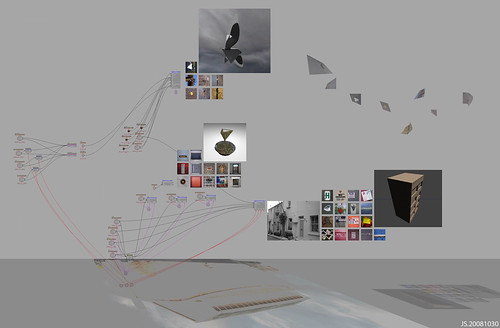
Kismet Posters


See them in larger resolution via my Flickr stream: http://www.flickr.com/photos/schwartzalot/2986568882/in/photostream/

Monday, October 20, 2008

DRAFT 2: proof


Music by Cake.

Poster and 500 words to come.

Thursday, September 11, 2008

Nature Spheres: Inversion

This post follows my Nature Spheres post.

Like the Eden Project, the Lost Gardens of Heligan is a bit of a theme park. However, it is the grown up and matured version of the Eden Project. Its collection is marked by cultural uniqueness rather than structural uniqueness; It is the permanent home and birthplace of produce, rather than a stadium where produce is brought to be marketed. It has geometrical forms, but rather than contain nature they support and are intertwined by nature. It is not an overly expensive cause of tourist congestion at the expense of small towns, its restoration revitalised the gardens "but also the local economy around Heligan by providing employment." (Wikipedia)


Heligan Gardens [Wikipedia]
Heligan Gardens [Official Website]

Nature Spheres

There's something about geometrical greenhouses containing sample ecologies that just seems grand. I guess it says, "Science owns nature" or something similar. It's the modernist ideal, isn't it?

So to continue the formal study, what or who owns science, and how does that get represented? The Biosphere 2, originally built by a cult-like organisation as a sealed experiment, has been given to the University of Arizona, and its surrounding land will soon be filled with suburban houses. It is the odd piece of history around the corner.

The Eden Project is more recent, and not in desperate search of support. Its calendar is dotted with festivals and celebrations, and operates almost as a theme park. Like most theme parks, it has land distinct from any urban centre. Its bubbles exist in a world apart from ours.


Biosphere 2 [Wikipedia]
Biosphere 2 [Official Website]
Eden Project [Official Website]
Eden Event Diary [Official Website]

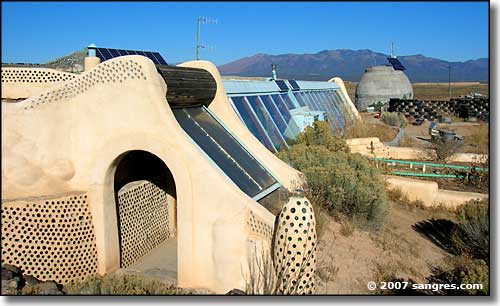
Earthships: The individual within the whole

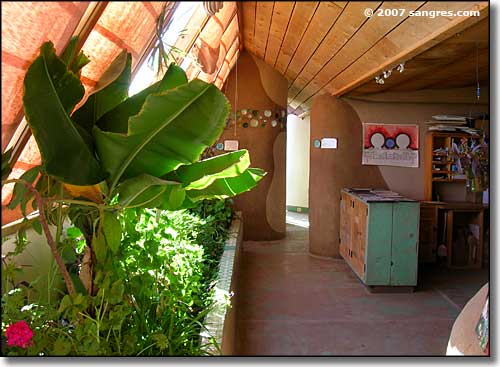
I visited the Earthships a few years ago, and have used them as precedent studies within a number of projects. Their paradoxical embrace of both self-reliance and interdependecy are poetry through function.

Although I couldn't see a whole world dotted by these off-grid houses, I could see a whole world teeming with their sensibility (a utopia, no doubt): Keep your environment personal, take time to think creatively, and always remember that you are part of a larger whole.


Earthships of Taos, New Mexico [Sangres]

Monday, September 8, 2008

Green Between the Cracks

The influences of guerilla gardenning and trash mirrors converge, in this post about moss-based graffiti:


The graffiti is grown in lines of text, the wall framing a single line of a larger poem - the entirety of which will show up over time on various walls around town. Not quite as responsive as the trash mirrors, but also reflective - in a different way.

Perhaps there's also something of the telectroscope here too, in the emergent connection of different places.

20 Masterpieces of Green Graffiti [Environmental Graffiti]

Friday, August 29, 2008

Draft 1: Zoom, Pan, Rotate


"URBAN ECOLOGY" - the rapidly narrowing title for my graduation project.

Music by Mason Jennings.
2 minutes of video, composed from renders using 3D Max.


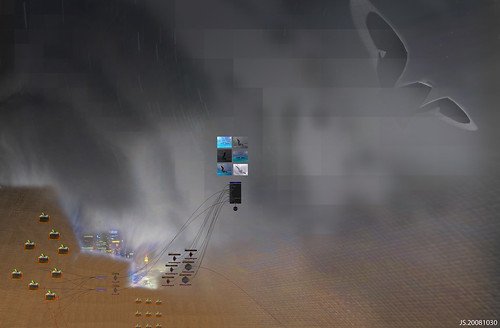
Draft 1 further details my investigations into ownership and environment. This research is broached by tracing urban bodies of such a scale that people are like cells in a living creature. Such an image is foreboding and wondrous at the same time. Symbiotic with this great creature are a variety of smaller creatures. These smaller creatures evolve by necessity in such a way as to recombine elements dispersed by the larger creature. Thus my research takes the guise of a life cycle and interdependency diagram that has a life of its own.

The diagram is navigated by assigning zoom, pan and rotate to various modes.

Zoom associates with Point of View, such as the identifiable everyday experience of travelling through a transport tunnel. Point of View later allows the viewer to become other things, such as the smog itself; the viewer zooms away from the ventilation stack and gains an aerial view seen more often by birds than people.

Pan associates with systemic mapping. The viewer gains a sense of larger symphonies, such as the tunnel. It carries smog to ventilation stacks, but is also like a leaky pipe; Seeds flow within and around it, being nourished and finding cracks to grow in. Systemic mapping starts with a known item (the tunnel) and ends by mapping a new, unrecognised system (the smog island, complete with craters).

Rotate associates with growth; a community garden ekes out of the cracks between concrete boxes. Growth is the devalued creating value of itself, a garden carving a rotated crater from solid smog – and establishing a prime economic market of carbon offsets.

Rising problems caused symbolically and realistically by the ventilation stack are visualised as decreasing distinctiveness in our urban environment. Thus as smog rises from our tunnels, it rises from the ground as a solid barrier – an urban island of oppressive solidity. This veil is not just smog, it is the sealed earth and manicured public gardens which tolerate little creatures only as outlaws. From and with this solid mass, various potentials are created. Existing elements, otherwise in a state of dispersal (such as locals losing out in a wave of gentrification) are able to recombine in successful ways. (Community) seeds can be planted, (economic) landscapes sculpted and (ecological) worlds can be uncovered.

Thursday, August 14, 2008

Valuing the Devalued

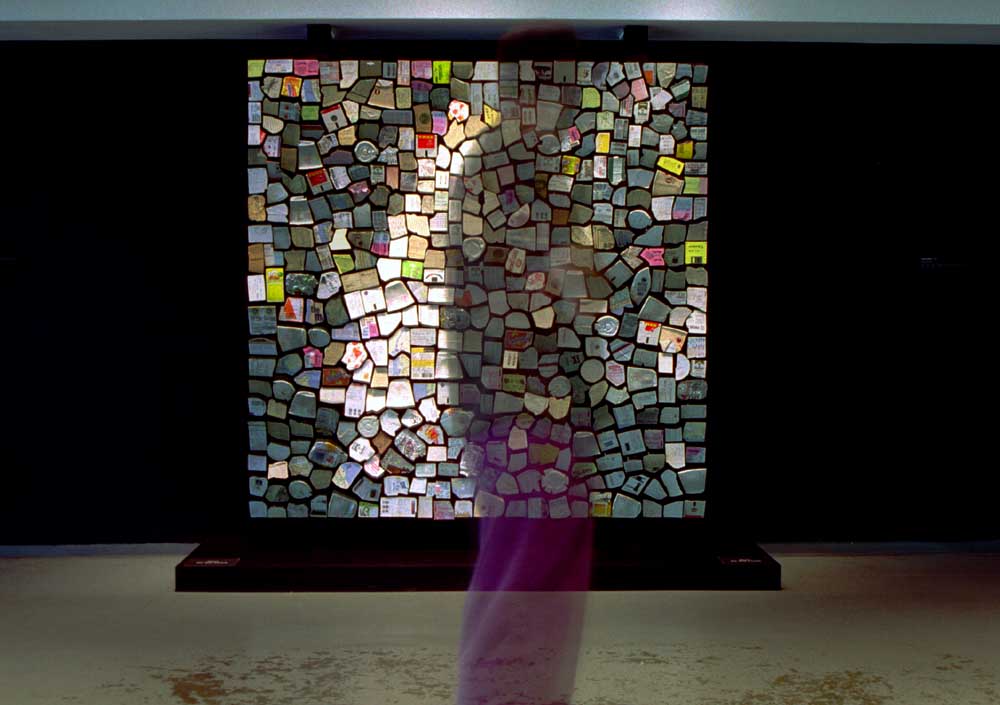
This relates to my Experiment 2 texture series about Discarded/Devalued, as well as Portals. If we can find honest value in the humble or downtrodden, we will be able to face our own problems with conviction.


"This piece suggests that we are reflected in what we discard. The piece celebrates the ability of computation to inflict order on even the messiest of substances - trash."
-DANIEL ROZIN, about his Trash Mirror.

Friday, July 11, 2008

Interopable Worlds...

... or, Fluid Activities in Many Native Environments

In "Virtual teleportation arrives" on Thursday, Aharon Etengoff says that "teleporting an avatar between platforms will undoubtedly have a significant impact on the future of virtual worlds. Indeed, an open standard for interoperability would permit users to cross seamlessly from one three-dimensional universe to another."

To me, the advantage of "teleportation" between worlds would be in moving more than just your individual appearance. As one commenter notes, just being able to move your avatar would be like "being in facebook and being able to switch to myspace without having to type your username and password again. Nice, but not earthshaking."

As another commenter sees it, "My buds and I might be in a game of BF2342 some day and escape an ambush by being teleported into the Sims10, then over to Quake Wars7 grab some new weapons and teleport back to the BF2732 game just behind our ambushers and zap em?"

- YES! You should be able to move so fluidly between worlds, with your objects and friends, that you can put each environment to its highest and best use, without messing up your train of thought. You should be able to span your activities across multiple worlds, because each world has its own rules, process and value in what you're doing. More than that, when you move from place to place, it's not just you and your files that're moving. Most of the time you're in the middle of a social activity, so you should be able to move with your friends by your side - rather than losing and regaining contact once you arrive. Portals should frame social settings, digital or not.

We shouldn't be looking at digital design in terms of booleans and polygons, we should be looking at swarming, cellular automata and other fluid patterning. And in our increasingly internet-augmented real world, people may demand more fluidly porous ways of navigating our places.

Virtual Teleportation Arrives, And Is Commented On [The Enquirer]

Wednesday, July 9, 2008

Powerthirst

I was going to post something deeply meaningful, but instead I found a video which embodies everything I would like to be able to do with machinima. It's awesome.

Saturday, June 21, 2008

Research Abstract

DESIGN, INNOVATE, MARKET

Living in the city is not an easy prospect. Proximity to high quality facilities is paid for with small private spaces, high costs, community tension and delirious places. People can often get lost in the equation – this is demonstrated near the chosen project site with large numbers of “keep out” signs and a looming ventilation stack operated by a corporation. The stack spews out concentrated smog from cars passing far below the surface, not to mention the loud and obnoxious stream of motor vehicles to be found above ground at what is a key intersection for Sydney’s traffic. Perhaps this is not such a healthy site for healthcare to take place.

Evidence of individual attempts to fight back are also to be found: graffiti extends individual ownership over places which are otherwise alienating. For instance, the prominently located, intricate pattern of cups lodged into a barbed wire fence. A back-street attempt at fighting back also includes a private garden overflowing onto public sidewalk. Such displays are exciting and interesting, but only exist on the surface. Surry Hills, Darlinghurst and Paddington are areas where a large number of small creative elements are able to combine and build character as community. Surely something truly powerful can be achieved through coordination.

Thus two major issues are to be dealt with in this project: First, a preventative health care umbrella to address the local and wide-reaching issue of air pollution. Second, enabling the mediation of big organizations and a potentially strong community. It should be noted that health is always personal, and good health is rarely found in isolation.

Precedents to address this nexus are to be found locally and overseas. Community gardens, while present in a few suburbs, are undervalued in Sydney for their widely affecting qualities; they are used quite effectively in education, addressing environmental health and for social support structures in cities such as Chicago. A community garden would however only address some of the issues. If organised in synergy with operations such as the “Spare the Air” campaign, a public living room, and environmental awareness spaces, a true umbrella might be lifted over the heads of local residents to address the issues of air pollution.

Precedents are also to be found that focus on the second key issue. Humanising elements of a scale relevant to big organizations is the name of the game. In New York, “HighLine” is an elevated railway converted to a very long public park. In Toronto, Jarvis Square is the home to a group of tall multi-jointed crane-like lighting masts. The masts are interactive, and can be controlled by passers-by for the price of a coin. These projects are about achieving relevance within something larger, and the idea that we feel better when we – as individuals – matter.

Further elements of change are already present, but need to be revealed. Wide swaths of the community are able to feel like they are part of something bigger, and need only be sitting at their computers to do so. Games like World of Warcraft attract diverse members of the community to unite through group activities. The problem with this kind of community is that it does nothing to enrich daily activities, nor the streets around our homes. For instance, if your friends all decide they want to fix something in their lives, and make a go of it as a group, you have a greater support structure in place if you decide to be part of that effort to quit smoking. Digital communities have a hard time enabling this kind of behaviour because friends in World of Warcraft probably don't share the ritual of smoking, living as they may on opposite sides of the world. We are having trouble transferring the things gained in our simulations to the things we need in reality.

From London to Manhattan, a “telectroscope” bridges two places out of sync. In someone’s basement, their dog is playing virtual soccer. And very soon, your IPhone will be anonymously informing the world of interesting places in your neighbourhood, merely by analysing the places that you frequent. Transference of skills, traits and values from our rapidly growing digital worlds requires familiarity and overlap as one moves between the virtual and the physical. In my Experiment 4 video, I exhibited some walking garden-type air filters as a community. They are abstractions of an architectural proposal for greenhouse spaces, but perhaps as they arrive on site as built work they can also arrive in World of Warcraft villages, Second Life or maybe even become mirrored at another physical city.


Woolloomooloo Community garden [ACF, CG.au]
Edible Schoolyard, Chicago [ESY]
Jarvis Square Light Masts [Waterfront Toronto]
New York Highline [The Highline]
World of Warcraft (WoW), Telecroscopes, virtual soccer, IPhones and social networks [aPart of aLife]
Health is Not Lonely [aPart of aLife]
Experiment 4 Video [aPart of aLife]
Abstract Brief [Russell Lowe]

Friday, June 20, 2008

Experiment 4


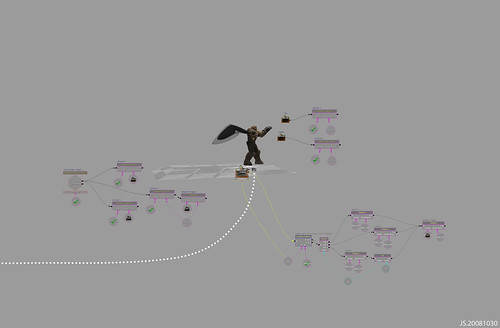
The soundtrack is based on music by Coco Rosie, and some model elements were created by other members of the studio.
UT3 cooked level, 50mb [FileFront]
Quicktime high-res video, 18mb [FileFront]
Experiment brief [RussellLowe]

Monday, June 9, 2008

Not So Healthy Site

A bit of discussion on the site and context that we're choosing to locate a healthcare facility within. The affect of motor vehicles is a key aspect of this particular location, both directly (at street level) and through the tunnel ventilation stack centred on site. Its character, both literally and metaphorically, was a key aspect of our response in Exercise 3 (and my Exercise 2). For both my proposal of a community health club, and end users of any healthcare facilities, dealing with this issue on this site is central and urgent.

At first glance it's a major drag. It's such a big issue! How can anyone have any impact on it? An obvious solution would involve lots of pollution-cleansing and sound-mitigation screens, to the point where you feel reassured and secure. Well, if living machines can transform waste water, and community gardens can unite all walks of life in the goal of nurturing, maybe individuals can do their bit. And maybe it can be a beautiful bit.

"Emissions from industrial facilities and electric utilities, motor vehicle exhaust, gasoline vapors, and chemical solvents are some of the major sources of nitrogen oxides and volatile organic compounds. Nitrogen dioxide is the main component in ground level smog and produced by combustion or heat in buses, cars, truck engines from the gasoline and diesel fuel...

Car or truck engines that are idling during peak traffic hours releases twice as many exhaust fumes than other vehicles in motion because there are lesser amounts of intake air. The chemical and exhaust emission levels from cars and trucks result in the formation of nitrogen dioxides and hydrocarbons from the incomplete burning of gas and diesel fuels during combustion."

(from Applied Ozone Systems website, http://www.appliedozone.com/smog_buster.html)

Friday, May 30, 2008

Group Model Tasks

Following our studio meeting today, here are the task assignments:

Jacob: Boundary map, contours, roads & footpaths
Kimberley: The stack vent & the Eastern Distributor tunnel
Jules: Vegetation, street furniture/power lines, solar data
Jodi: Terraces adjacent to the southern boundary, Russell's building
Vinh: Palace Hotel, Moore Park "pointy bit" on southern side of intersection
Noa: Purple building
Jason & Dennis: Buildings on the western side of the laneway (split this between yourselves)
Fruz: Antique shop & other buildings on eastern side of intersection, photography

Make sure you've got your information before next Thursday, as that's when we'll be meeting to do the modelling. Also, if you still aren't acquainted with Solid Works, make sure you get some time in with the tutorials before Thursday so you don't run out of time and let the team down.

We'll have the laptops booked for Thursday, and on Friday we'll be putting the model together first thing. I'll make sure I've got mine done before Thursday, so that you can all work off a common base map in Solid Works. Post any questions or issues as comments for this post.

More signs of WoW culture

The Sydney Morning Herald is picking up a story written by the New York Times, that compares World of Warcraft to Star Trek in terms of cultural impact. wow.

I think WoW is fundamentally different to Star Trek, in terms of fan culture. For one, WoW is more about team and character building than it is about collectables and idolisation. As with all computer systems however, the fundamental problem is that most people have to sit at a computer to take part. What if WoW could enrich going to the shop, or going to school? I'm not talking about home schooling here - I'm talking about transfer of culture. We all use social networking websites, they add a rich layer of communication to the social networks we have in the physical world. Why can't games like WoW add a rich layer to our physical lives too? Why can't we benefit more from the things gained in games?

EDIT: Maybe telectroscopes can be used to connect the physical and game world.

"When the sun illuminated the lens of the Telectroscope next to the Thames, it was, of course, still nighttime in New York. So the screen inside the scope broadcast back only an empty sidewalk silently framed by the Brooklyn Bridge and the Manhattan skyline.

But then something miraculous occurred.

A police officer and a street cleaner walked into the frame. Stopped. And waved."


EDIT: This youTube clip shows that you can play virtual soccer without sitting at a console. Maybe you can play WoW similarly without sitting at a console...

Link

EDIT: Other directions for enriching reality with digitality include the new IPhone, and CitySense. The IPhone incorporates a good interface, can sense which way you're pointing it, has GPS, fast internet and an ever-increasing amount of grunt for games. Most of all, like the IPod it will probably attract the whole range of community. CitySense takes that platform to another level, effectively turning real life activities of the mobile phone toting masses into an intelligent "discovery application" capable of leading us to what we want to do, rather than where we want to go.


Blackberries tell us things [DMNews]
IPhones are only going to get more awesome [BusinessWeek]
Telectroscopes: telescopes through the world [CNN]
How some guy kicked the WoW habit [SMH]

Thursday, May 29, 2008

Health Is Not Lonely

I think we mostly knew this already. Pretty much everything we do fits into our social sphere, and any addictions we have are likely to be found in our friends too. This can be a good thing and a bad thing, and it depends entirely on the mentality of your social setting. If your friends are gun ho on doing crazy shit, you're probably going to want to go along with them or get new friends. Alternately, if your friends all decide they all want to fix something in their lives, and make a go of it as a group, you have a greater support structure in place if you decide to be part of that effort to (for instance) quit smoking.

Yes, according to the New York Times (so you know it's true)
"Smokers tend to quit in groups... which means smoking cessation programs should work best if they focus on groups rather than individuals. It also means that people may help many more than just themselves by quitting: quitting can have a ripple effect prompting an entire social network to break the habit."

I suspect that this principle applies to almost any aspect of human health. This links into Fruzi's post about community health clubs. In this context, Christopher Alexander's model can be broadened to deal with any addiction or trend we see as negative in the community, and possibly even to detect illnesses lurking beneath the surface. We've become a very transient people, and the neighbourhood we grew up in may not be the one we will spend even the next 10 years in. As such, local issues change too quickly to relocate specialised healthcare whenever the community demographic changes.

A community health club should be a platform for self directed health rather than a static formula. It should enable people to address things in their lives, bring their friends along (maybe make new friends), and to do so in a setting where support and consultation is available from people who are experienced or qualified to give good advice. It should encourage participants to bring their own time and effort into the arena, so that we can have a Wikipedia/Facebook/Flickr solution rather than a Britannica solution.


Big Social Factor in Quitting Smoking [New York Times]

Friday, May 23, 2008

Ex3 Position Statement


The site during the day lives on the boundary between the explorative, the realm of texture, taste, fragrance, sounds – and the peripheral, that of driving past without noticing anything other than the slight chill down the spine, as the ominous smoke stack spewing out its filth looms briefly overhead.

While the various scales and movements around the site exhibit a split world, still more subtle is the disconnect between wildly different pedestrian identities that inhabit the area. There is the drunk who wakes up in the shadow of narrow back lanes, or on the doorstep of a young family’s heritage terrace. There are the groups of subversives who graffiti everywhere and anywhere, in an attempt to extend their ownership over a place already mired by signage posted by the “official” owners of buildings. There is the social shadow cast over every local by the Eastern Distributor ventilation stack, on a site owned by the RTA and distinguished by its inhabitability. Clearly, the site is distinguished by cultural silos.

Far below the surface is a stream of cars, most active in the periods marking sunrise and sunset. The arrival of accompanying smog is the most widely relevant output of the site; it is the opening and closing act of the site’s daytime drama.

Pollution spewed from the site itself sits in watch over the silos of human activity. It broods, watches, infects. The brooding, the space, the melancholy of the activity that occurs is the inhabitant, is the character of the site. One feels that the site, the bricks and mortar, sand and cement may be built on, but the character of the site, the one that exists there at this time will not be shattered, will not change. One feels that it will move, walk down the footpath to the alleys and back lanes of Surrey Hills, stand up the sign of no trespassing once again and continue on uninterrupted with its life.

The work of high power simulations these days is a reconfiguring of player positions, finding ways to enable collaboration of personified identities – teams, organisations, matter. In embodying the perceived meaning of these identities, we hope that such identities can be dealt with rather than overlooked.


Experiment brief [RussellLowe.com]

Sunday, May 11, 2008

Commuters are Like Sheep

This is a little random, but I believe right on topic. The Sheep Market is a project paid for by Amazon and made using Processing (P5). I was involved in the Processing community a while back, when P5 was still in alpha release.

In the Sheep Market, there are so many sheep that the cumulative effect is awesome. Each sheep was created by a different random person through a webpage, and when you click on one you can see an animation of the sheep being drawn. Everyone draws a sheep differently. There are 10,000 sheep in all, each a mini story. After watching a couple of sheep being drawn, that cumulative effect becomes even more awesome because all of a sudden you're staring at a huge library of human character studies instead of a huge library of crude drawings.

When you approach the project site, the cumulative effect of all the cars is also awesome - though in a different way. The stream of cars is alienating, for a variety of reasons. And because you can't pick one up and see the character in each, you can't really deal with the reasons you're being alienated. There's no way to see the value in all those people and machines. It's just too random.

10,000 sheep at $0.02 each [The Sheep Market]
Processing, initiated by Ben Fry and Casey Reas [processing.org]

Unreal Reference

I've been on the hunt lately for good, thorough UT3 reference manuals. Here are a couple good sites which I've had a quick look through. It seems obvious that there is editing, and then there is editing:


A complete kismet reference by the makers of the platform [EpicGames]
Details of something which I very much want to get into: UnrealScript [utwente.nl]
Unreal Wiki [beyondUnreal]
Unreal Developers Forum [beyondUnreal]
A pretty huge list of tutorials all over the web [IceCreamYou]
Player-specific kismet [Epic Forum thread]
Exporting from Max [PlanetUnreal] [waylon-art]


Btw Russell, we were talking about the ability to pull stuff into and out of the internet while in gameplay... At a glance, it looks like the LibHTTP library in UnrealScript might enable it.

This post on the forum looks very interesting, particularly in light of architectural workflow. Imagine if you could meet an engineer in the UT3 model of a building you're designing, while inside the VM collaboratively modify the building's elements, and then have that communicated back to your drawings or BIM.